
Employment Law Changes from April 2026: What Employers Need to Know
From 1st April 2026, several important employment law changes will start to take effect, with further updates following shortly after on 6th April 2026. For many employers, these changes will have a direct impact on pay, family leave, sickness absence, compliance, and internal HR documentation. While some updates may only affect certain businesses, others are likely to have a much wider reach.
As with any legislative change, the most important question is not just what is changing, but what you need to do about it. Taking time now to understand the reforms and prepare your policies, contracts, and processes will help you stay compliant, reduce risk, and avoid last-minute pressure as the new rules come into force.
In this blog, we’ve set out the key changes employers need to be aware of ahead of April 2026, including reforms to Statutory Sick Pay, increases to National Minimum Wage, updates to parental and paternity leave rights, the launch of the Fair Work Agency, and extended whistleblower protections relating to sexual harassment. We’ve also highlighted who is likely to be affected and the practical steps you should take now to get ready.
What is happening, does it impact you, and more importantly, what do you need to do?
1. Reforms to Statutory Sick Pay (SSP)
Removal of Lower earnings limit
Will this impact you? Yes - If you pay employees SSP (No if you pay Contractual sick pay).
What should you do? Pay SSP at a rate of either 80% of weekly earnings, or the flat rate (£123.25 per week), whichever is lower. Update Contract clause/ employee handbook and Sickness Absence Policy.
Removal of waiting days
Will this impact you? Yes - If you pay employees SSP (No if you pay Contractual sick pay).
What should you do? Pay SSP from Day 1 of sickness absence. Update Contract clause/ employee handbook and Sickness Absence Policy.
2. Increase in National Minimum Wage
Increase in NLW (21+) and NMW for all age groups from 1st April 2026
Will this impact you? Yes - If your employees are currently paid at NLW or NMW
What should you do? Ensure rates of pay from 1st April 2026 are in line with rates in Table 1. i.e. Employee 21+ to be paid at £12.71/hr.
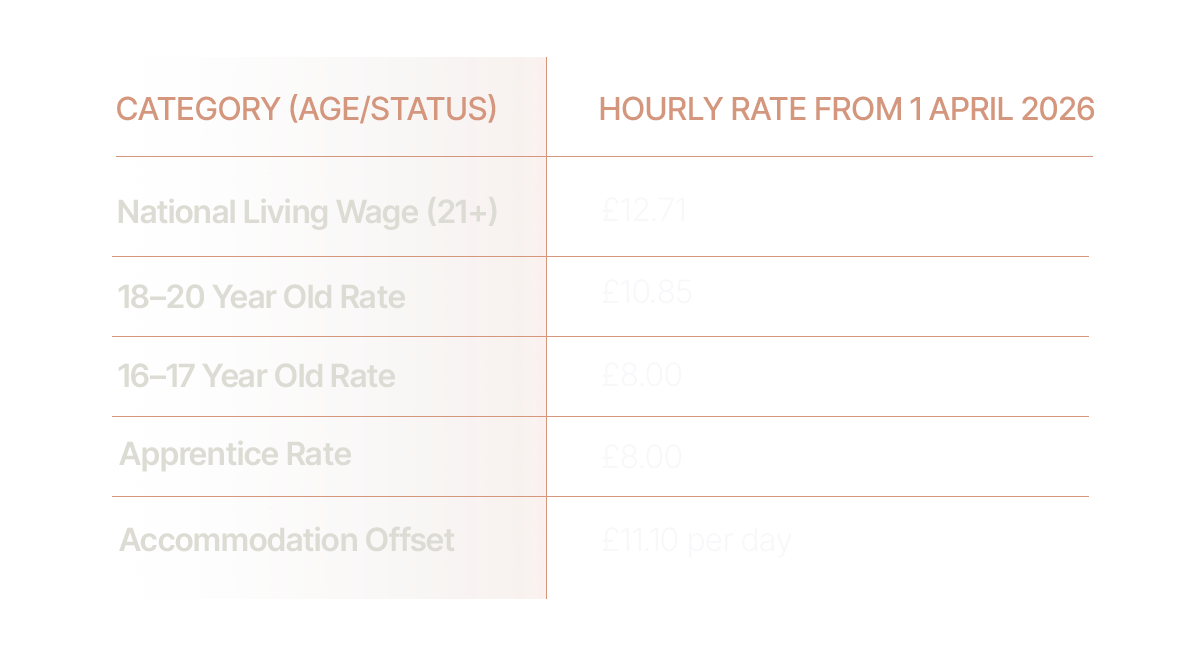
National Living Wage & National Minimum Wage Rates from April 2026
3. Parental leave
From 6th April 2026 Parental leave will become a day 1 right
Will this impact you? Yes - If employees request their right to take up to 18 weeks’ unpaid parental leave in total for the purposes of caring for a child.
What should you do? Accept applications for parental leave from 18th Feb 2026. UpdateContract clause/employee handbook and Parental Leave Policy.
4. Paternity leave
From 6th April 2026 the service requirement for paternity leave (Currently, employees need 26 weeks’ service by the end of the 15th week before the expected week of childbirth (EWC)) will be removed
Will this impact you? Yes - if employees request their right to take up to two weeks' paternity leave after the birth or adoption of a child.
What should you do? Accept applications from employed parents where they have:
babies with an EWC on or after 5 April 2026
babies born on or after 6 April 2026
or children placed for adoption on or after 6 April 2026.
Update Contract clause/ employee handbook and Paternity Leave Policy.
5. Launch of the Fair Work Agency
Launching April 2026, the Fair Work Agency unifies enforcement of employment rights, strengthens investigations, centralises guidance, and increases scrutiny of pay, working time, and compliance for UK employers across sectors
Will this impact you? All UK employers could be affected, but those using variable hours, agency labour, shift work, or operating in sectors previously monitored by multiple enforcement bodies will experience the biggest impact under the Fair Work Agency.
What should you do? Employers should review pay and working‑time compliance, update HR policies, strengthen record‑keeping, and prepare for stricter investigations in 2026 ahead of the Fair Work Agency’s enhanced enforcement.
6. Extended whistleblower protections relating to sexual harassment
Employees will be protected from suffering a detriment because of making a disclosure around sexual harassment. Any dismissal for this reason would be automatically unfair
Will this impact you? Yes- if you are managing a disclosure from an employee or worker around:
Criminal offences,
legal non‑compliance,
miscarriages of justice,
risks to health and safety,
environmental harm,
deliberately concealing such wrongdoing
What should you do? Update Whistleblowing policy.
Pre-April 2026 employer checklist
Review whether your business pays Statutory Sick Pay or contractual sick pay, and update payroll processes to reflect the removal of the lower earnings limit, the removal of waiting days, and day 1 SSP payments where required.
Update your contracts, employee handbook, and Sickness Absence Policy to reflect the new SSP rules.
Check that all employees paid at National Living Wage or National Minimum Wage will be paid the correct new rates from 1 April 2026, and update payroll, budgets, and any accommodation offset arrangements accordingly.
Prepare for parental leave becoming a day 1 right from 6 April 2026, including accepting applications from 18 February 2026 and updating your contracts, employee handbook, and Parental Leave Policy.
Prepare for the new paternity leave rules from 6 April 2026, including removing the service requirement, accepting eligible applications, and updating your contracts, employee handbook, and Paternity Leave Policy.
Review your pay, working time, and record-keeping practices ahead of the launch of the Fair Work Agency, especially if your business uses variable hours, agency labour, or shift work.
Update your Whistleblowing Policy and make sure managers understand the extended protections relating to disclosures about sexual harassment.
Brief managers on the upcoming changes and make sure internal processes are ready before the new rules come into force.
If you’re unsure how these changes may affect your business, or you’d like support reviewing your contracts, policies, and processes ahead of April 2026, Circle HR is here to help. We also offer a dedicated HR documentation service, supporting businesses with contracts of employment, employee handbooks, policies, and other essential HR documents. Get in touch to find out how we can support you and help your business stay compliant, confident, and prepared.
Sarah and Niall
Circle HR